Why does this movement still fascinate people today?
In an age when images are everywhere and everything seems capable of being reproduced endlessly, certain works still manage to evoke an immediate emotional response. Without depicting a landscape, a face, or any identifiable object, they captivate, provoke thought, and touch us deeply.
That is precisely the strength of lyrical abstract expressionism.
Born in the aftermath of World War II, this artistic movement remains today one of the most sought-after forms of expression among contemporary art enthusiasts. Its evocative power transcends generations and continues to hold a prominent place in galleries, private collections, and exceptional venues.
A movement born of freedom
Lyrical Abstract Expressionism emerged in a world marked by the traumas of war. Many artists at the time felt the need to break away from the traditional rules of painting.
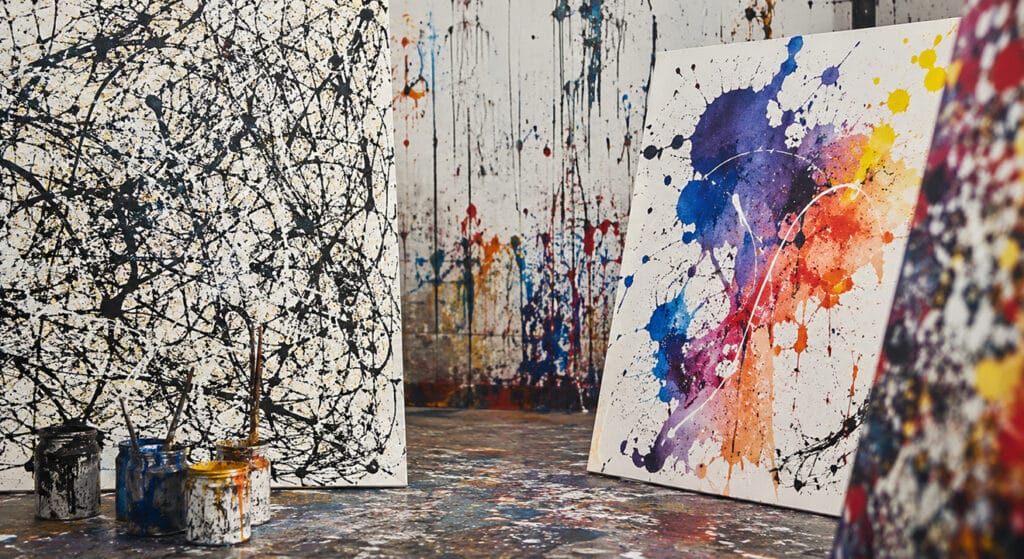
Rather than faithfully depicting reality, they choose to paint what cannot be expressed in words: emotions, energy, inner movement, and the moment.
That is when the action becomes essential.
The canvas ceases to be merely a surface to be decorated; it becomes a direct extension of the artist.
Every brushstroke, every stroke of paint, every layer conveys an emotion experienced at the very moment of creation.
When Gesture Becomes Language
Contrary to popular belief, lyrical abstract expressionism is not a form of painting created at random.
Behind its apparent spontaneity lies a perfect mastery of composition, color, rhythm, and balance.
The movement’s leading artists—such as Hans Hartung, Georges Mathieu, Jackson Pollock, Sam Francis, Joan Mitchell, and Jean-Paul Riopelle—each developed an immediately recognizable pictorial style.
Their signature lies not in the subject they depict, but in the way they occupy space, let color flow, and convey a unique energy.
It is this artistic identity that makes their works so powerful.
A universal emotion
One of the reasons for the enduring fascination with lyrical abstract expressionism is its ability to speak to everyone.
When viewing a figurative work, the viewer often tries to identify what they see.
When viewing an abstract work, they first look for what they feel.
Two people looking at the same painting may have completely different experiences.
One might see a storm.
The other will see a birth.
A third person will simply find deep peace in it.
No interpretation is wrong, because the artwork does not tell a predetermined story: it opens an intimate dialogue with the viewer.
Art That Transforms Spaces
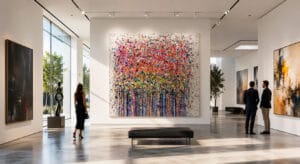
Lyrical abstract expressionism also possesses a rare quality: it engages naturally with architecture.
In a contemporary home, a luxury hotel, a corporate headquarters, a fine-dining restaurant, or an exceptional villa, a large abstract artwork quickly becomes the focal point of an entire space.
It brings a sense of presence.
An identity.
An emotion.
That is why architects, interior designers, and collectors are increasingly turning to this artistic movement when they want to create unique spaces.
The artwork no longer simply adorns a wall—it plays a full part in shaping the atmosphere of the space.
Why does it continue to appeal to collectors?
For several decades, the art market has shown a steady interest in the major artists of Abstract Expressionism.
But beyond their heritage value, collectors today seek works capable of evoking genuine emotion in their daily lives.
Lyrical Abstract Expressionism perfectly meets this expectation.
Each canvas is unique.
Each brushstroke is irreversible.
Each work carries the memory of its creative process.
In a world where standardization is gaining ground, this authenticity becomes particularly valuable.
A source of inspiration for contemporary artists
The influence of lyrical abstract expressionism extends far beyond its own era.
Many contemporary artists continue today to explore the gesture, the material, the color, and the freedom of expression inherited from this movement.
They do not seek to imitate their predecessors, but rather to carry forward the same philosophy: to make painting a living language, capable of conveying what words cannot express.
This continuity explains why lyrical abstract expressionism is not merely a historical movement.
It remains a source of contemporary creativity.
Merlinvest: Bringing the Emotion of Art to Life
At Merlinvest, we believe that art is not limited to its aesthetic or heritage value.
A successful work of art transforms a space, fosters connection, and has a lasting impact on those who experience it.
Lyrical Abstract Expressionism fully embodies this vision.
Through its freedom, intensity, and ability to evoke ever-renewed emotions, it continues to inspire artists, collectors, architects, and art lovers.
Because some works do not seek to represent the world.
They simply invite us to experience it differently.